By Vitangelo Recchia
Roman pizza didn’t begin with a trend. It began with a stone, a fire and a flatbread. If you want to understand what it truly is, you need to understand where it came from before you can understand where it’s going.
I know this because I lived it. In 2006, I studied abroad and lived in Trastevere, Rome—one of the oldest, most authentic neighborhoods in the Eternal City. The vendors, the bakeries, the smell of olive oil and sea salt hitting a hot stone deck at six in the morning—that neighborhood got into my blood and never left. My formal introduction to the craft in America came through Massimiliano Saieva, one of the earliest Roman pizza pioneers in the U.S. Over the last 10 years, I’ve immersed myself completely—studying, producing, competing and teaching.
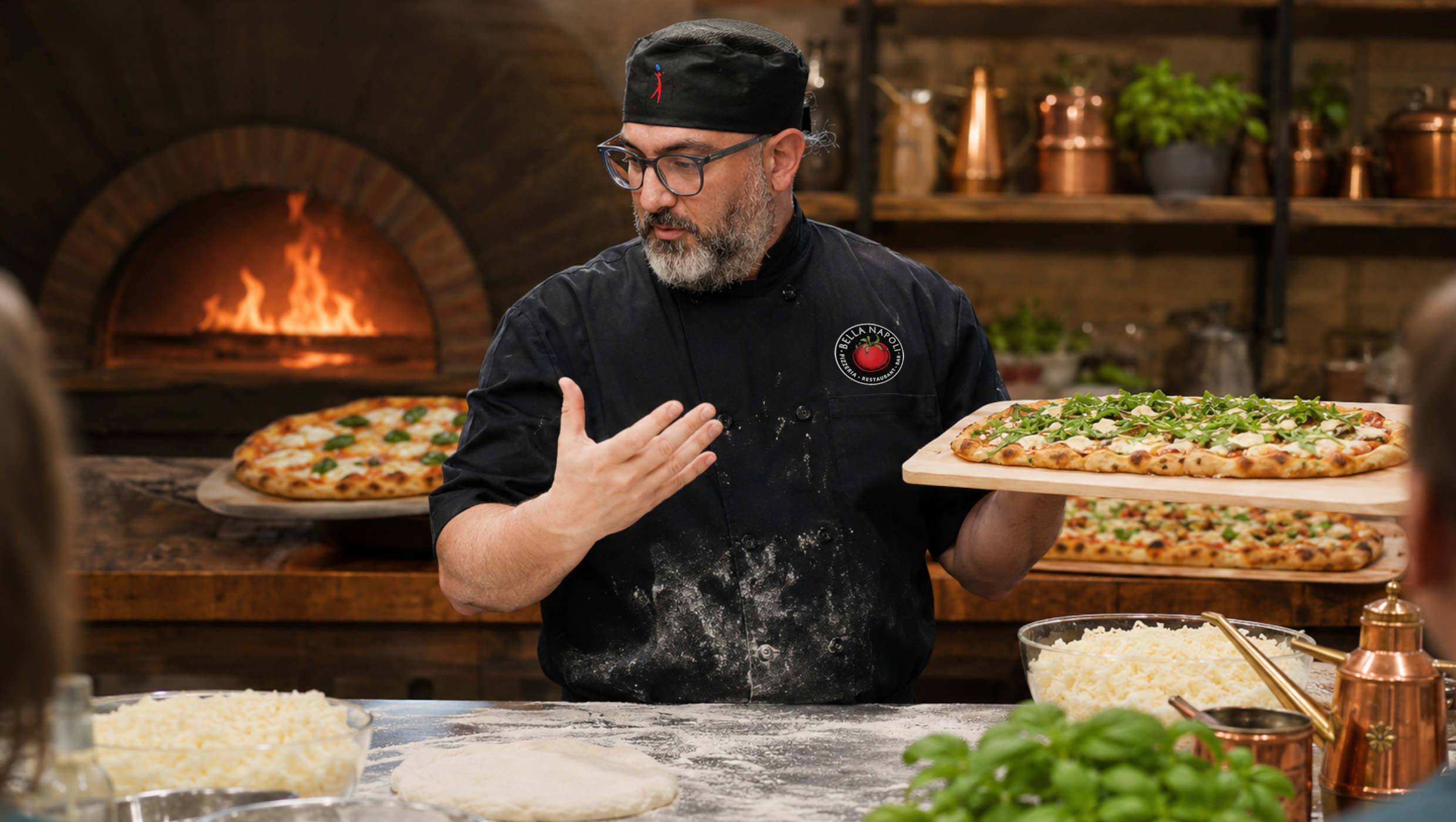
Today, I make Roman pizza every day at Bella Napoli Pizzeria & Restaurant in Port Charlotte, Florida, and teach it at Pizza University & Culinary Arts Center in Beltsville, Maryland. I serve as culinary coach for PMQ’s U.S. Pizza Team, building the next generation of American pizza competitors for the international stage. In 2023, I competed at the Campionato Mondiale della Pizza—the World Pizza Championship in Parma, Italy—against more than 700 competitors from 52 countries, finishing on the podium in the teglia category in my first international competition. From 2023 through 2025 I’ve held the title of Top Pizzaiolo USA in teglia.
But, beyond these credentials, everything in this article comes from hands-on experience: the dough, the mixer, the cold room, the electric oven, the competition floor and the classroom. This is not theory. This is practice, documented.
The Four Men Who Made This Tradition Teachable
Before I talk science, I need to name the people who built today’s Roman-style foundation. Without them, there would be no methodology to learn, no competition circuit to enter and no global market to serve.
Corrado Di Marco: He developed the pinsa Romana concept and the science of the multi-flour blend—wheat, rice and soy—that gave Roman pizza a format lighter and more digestible than anything that came before. His work on flour technology and dough maturation created the scientific foundation the entire industry now builds on. The pinsa, as we know it today, exists because of Di Marco.
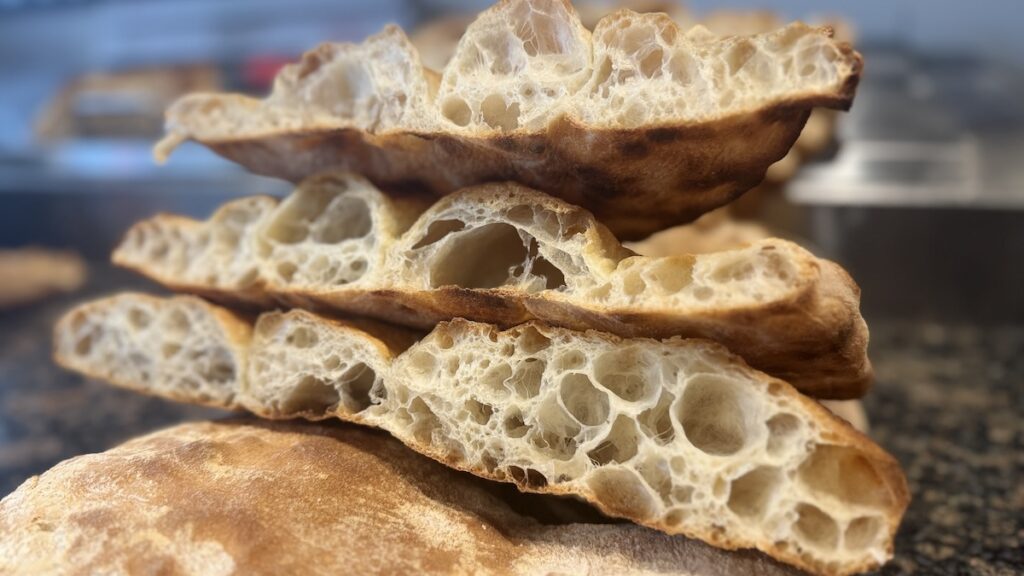
Angelo Iezzi: He built the cold fermentation protocol—dough fermenting for 48, 72, 96 hours under cold conditions—that is the direct ancestor of every serious Roman dough made anywhere in the world today. He did it by reversing everything the tradition had been doing. His breakthrough came when a freezer malfunction forced his experimental dough into the refrigerator overnight. It rose slowly and produced exactly the light, open crumb he had been chasing. From that accident came a formula he distilled as follows: “96 hours fermentation, 80% hydration, extra-virgin olive oil, buon appetito.” Every serious Roman pizza operation in the world traces its methodology back to what Iezzi built in that kitchen.
Enrico Famà: Born in Rome, a genuine Romano de Roma, he built the institutional house that Roman pizza lives in. In 1988, he co-founded the first permanent pizza school in the world at Santa Margherita di Caorle, which became the Scuola Italiana Pizzaioli. In 1991, he created the World Pizza Championship, running it as patron through 2010 and placing Roman pizza formats on the global competition stage for the first time. In 2021, he founded the Associazione Pizza Romana, dedicated to promoting and defending Roman pizza worldwide. His Accademia Pizzaioli now operates more than 140 pizza schools globally. His words: “When I entered the world of pizza, Roman pizza was made only in Rome and in Lazio. Now you can eat it all over the world.” That did not happen by accident.
Gabriele Bonci: Bonci showed the world what Roman pizza al taglio looks like at its absolute ceiling. When he opened Pizzarium near Vatican City in 2003, he worked with stone-ground heritage grain flour from Mulino Marino and a 72-hour cold-fermented dough, giving the world a reference point it had never had. His philosophy: procuring high-quality ingredients is as much a part of making pizza as kneading the dough. The recipe was only 10% of the success. Everything else was the handling—the “manipolazione.” By 2017, he had carried that vision to Chicago. The American conversation about Roman pizza began the moment he crossed that Atlantic.
These four men gave us the foundation. What follows is what you build on it.
The Spec Sheet
A Roman pizza dough is not a recipe. It’s a set of specifications, and if you can’t read those specifications, you’re working blind. Every morning at Bella Napoli, every class at Pizza University, every competition I prepare for, starts with the flour. The flour arrives with decisions already made inside it. Your job is to understand those decisions before you touch anything else.
The W-Index—Flour Strength: Measured by the Alveograph di Chopin, the W-index tells you the energy required to rupture a bubble of hydrated dough. It’s the single most important number on the spec sheet. W 180 to 260 is medium flour for standard applications. W 260 to 310 is strong flour—you’re beginning to get serious. W 310 to 400 and above is where serious Roman al taglio and pinsa production lives. When I competed in Parma in 2023, I was working flour in the W 320 to W 360 range. A 96-hour cold fermentation at 80% hydration is not gentle. A flour below W 260 will not survive it. If you do not know your W-index, you are guessing. You cannot afford to guess.
The P/L Ratio—Tenacity to Extensibility: P is resistance to stretching. L is the ability to extend without tearing. The ideal range for Roman pizza sits between 0.4 and 0.6—enough tenacity to hold structure through long fermentation, enough extensibility to stretch thin without the dough fighting you. In other words: Too high, and it snaps back. Too low, and it tears. You cannot learn this from a video. You have to feel it. That’s why the classroom exists.
The Brabender Farinograph—Water Absorption and Dough Stability: While the Alveograph tells you what the flour withstands under pressure, the Farinograph tells you how it behaves during mixing. It measures water absorption, dough development time, stability under mechanical stress, and degree of softening beyond peak. For Roman doughs at 75% to 85% hydration, water absorption is the difference between a dough that develops correctly and one that collapses in the cold room three days later. Development time tells you how long the flour needs to reach peak gluten strength—that’s critical when managing spiral mixer protocols at scale. Stability tells you how forgiving the flour is under extended mixing; low stability punishes you if you push one revolution too far. The softening value tells you how quickly the dough degrades after peak. Together with the Alveograph, the Farinograph gives a complete picture of the flour’s personality, both its strength and its temperament. In Roman pizza production, that temperament is everything.
The Falling Number—Enzymatic Activity. This measures alpha-amylase activity—how aggressively the flour breaks down starches during fermentation. For long-fermentation Roman doughs, I want a Falling Number between 280 and 350. Too low, and the dough feels perfect leaving the mixer but falls apart in the cold room days later. The Falling Number tells you what the clock looks like inside your flour.
The Ash Content—Minerality. Tipo 00 flour sits at 0.45% to 0.55% ash. Tipo 1 sits at 0.65% to 0.80%. I work with Tipo 1 (or blends incorporating Tipo 1) at Bella Napoli and in competitions—specifically, Molino Casillo Tipo 1. That higher ash content delivers the nuttiness, depth and complexity that pure Tipo 00 cannot produce. The grain remembers what it was. The ash content is the proof.
The Absorption Number. The absorption number on the spec sheet is a laboratory baseline. Your actual working hydration is shaped by water temperature, room temperature, mixing method and fermentation protocol. The absorption number tells you where the flour starts. Your process tells you where it ends up.
The Mills and the Grain
Italy does not grow enough wheat to supply its own mills. Understanding the global grain supply chain is part of understanding what’s inside your flour.
Mulino Marino stone-grinds heritage grain, preserving bran, germ and oil in a way modern roller milling cannot replicate. Gabriele Bonci built his entire production around it. Molino Dallagiovanna, founded in 1832 in Piacenza, is the only large Italian mill that still washes wheat in drinking water before milling; it has more than 450 flour types, including dedicated Roman blends, now in the American market.
In my production doughs at Bella Napoli, I use Tipo 1 from Molino Casillo, founded in 1958 in Corato, Puglia, Italy. Molino Iaquone, founded in 1950 in Vicalvi, Lazio, Italy, brings the stone-milling experience of four generations, with R&D focused specifically on Roman pizza formats, and is distributed across 40 countries. Naples’ Mulino Caputo, founded in 1924, is the flour most American pizzaioli encounter first when working with Italian product.
Canadian hard red spring wheat—from Alberta, Saskatchewan and Manitoba—at 13% to 14% protein is the backbone of every strong Italian flour. Without it, the W 320 flour I used in Parma does not exist. American hard red winter wheat provides consistency. Australian wheat provides Falling Number stability critical for long fermentation.
Finally, Ukraine and Russia, historically two of the largest grain suppliers to Italian mills, have been severely disrupted since 2022, which is why American operators felt their flour behaving differently without knowing why. Now you know.
When you understand the full chain, from field to spec sheet to dough, you can solve problems invisible to everyone else.
Vitangelo Recchia is owner of Bella Napoli Pizzeria & Restaurant and a master pizzaiolo and instructor. He is an instructor at Pizza University and Culinary Arts Center and culinary coach for the U.S. Pizza Team. He has been ranked Top Pizzaiolo USA in Teglia at the World Pizza Championship three years in a row.