I didn’t reach out to Arthur Erickson because he’s a pizza guy. I reached out because I’m a pizza guy who’s also a drone nerd.

As CEO and co-founder of Hylio, Erickson spends his days building autonomous drones that help farmers apply fertilizer with incredible precision. But years before Amazon made drone delivery a household conversation, he was already flying real deliveries in Costa Rica—including pizzas. As someone who’s spent more than two decades in the pizza business and flies drones as a hobby, I had to know: Is pizza delivery by drone actually the future, or are we all just chasing the opening scene from Ready Player One?
The answer surprised me. According to Erickson, the drones aren’t the problem anymore. The technology has largely caught up with the idea. What’s slowing things down are regulations, infrastructure and the enormous investment required to prove the system is safe enough for everyday neighborhoods.
Of course, pizza and drones have crossed paths before. Domino’s, Pizza Hut, Little Caesars and others have all made headlines over the years with promotional flights, pilot programs and limited-market tests. Most were carefully controlled demonstrations or small-scale trials designed to prove the concept rather than replace the neighborhood delivery driver. Pizza has even made the journey to space—Pizza Hut famously sent a specially prepared pie to Russian cosmonaut Yuri Usachov aboard the International Space Station in 2001 as part of a publicity campaign.
More recently, drone delivery has quietly moved beyond marketing stunts. Companies like Wing, Flytrex and Amazon Prime Air continue  expanding real-world delivery networks, and pizza is beginning to join the conversation. This spring, Anthony Pizzi, founder of The New Jersey Pizza Alliance held the inaugural xPizza Day at The Columbia Inn in Montville, New Jersey, featuring an autonomous pizza delivery by Dexa, showcasing what organizers called the first drone pizza delivery of its kind in the Northeast. The demonstration coincided with Dexa’s active commercial pilot program with Grubhub and Wonder in nearby Green Brook, giving operators a look at technology that’s already being tested outside the lab. Meanwhile, Flytrex has begun delivering full-size Little Caesars pizzas in Texas, while Papa Johns is also exploring drone delivery through its partnership with Wing.
That’s what made Erickson’s perspective different. He wasn’t trying to convince me drone delivery was possible—he’d already done it, and if his timeline is correct, he was one of the first. The bigger question, he said, isn’t whether drones can deliver pizza. It’s how long it’ll take before the economics and regulations catch up to the technology.
Hernandez: A lot of people assume the technology isn’t ready yet. Are they wrong?
Erickson: We’re much farther along in the technology than most people realize. We were doing fully autonomous deliveries, including pizzas, back in 2016 and 2017. We weren’t manually flying those drones. We were supervising them and had the ability to intervene if necessary, but the flights themselves were autonomous. Obstacle avoidance, route planning and autonomous navigation are all things that already exist today.
Hernandez: So what’s actually standing in the way?
Erickson: Economics and regulations. One drone delivering one pizza can absolutely save money, but there are a lot of development costs, legal costs and infrastructure costs that have to be overcome first. Then regulators have to be comfortable with drones operating safely over neighborhoods and populated areas.
 That distinction kept coming up throughout our conversation. Erickson believes carrying the pizza itself is almost an afterthought. Modern heavy-lift drones can easily handle multiple pizzas, drinks, heavier payloads and challenging weather conditions. The real challenge isn’t whether a drone can carry dinner—it’s convincing regulators that if something fails, nobody gets hurt.
He compares the situation to self-driving cars. The capability often arrives long before public acceptance and government approval. Backup flight computers, redundant GPS systems, parachutes and countless hours of testing are all part of earning that trust.
Hernandez: Will restaurants eventually own their own drone fleets?
Erickson: “Probably not. I think you’ll see delivery networks develop first. Large logistics providers will build the infrastructure, and restaurants will plug into those networks. That’s probably the most practical path forward.”
Hernandez: What does drone delivery look like 10 or 15 years from now?
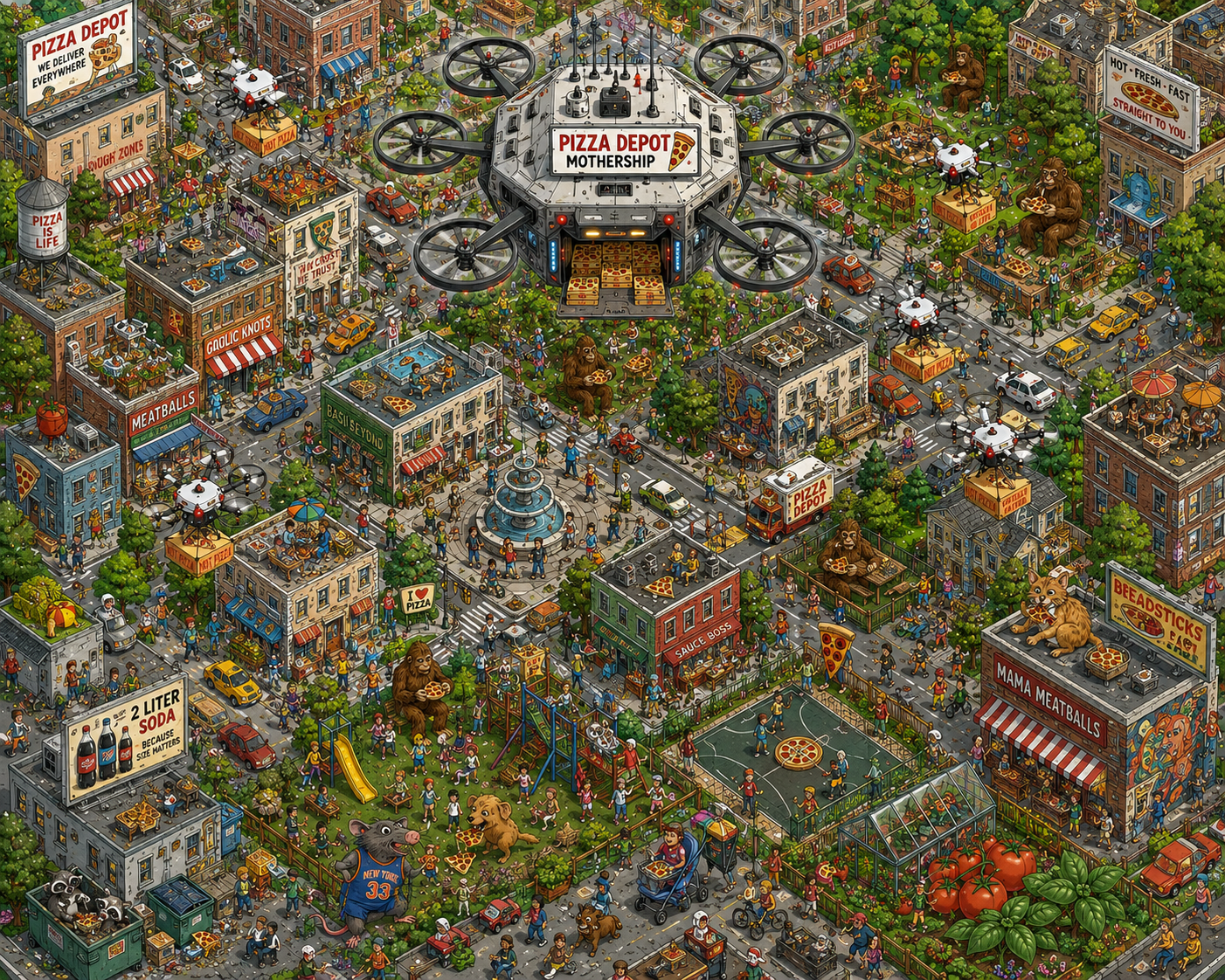
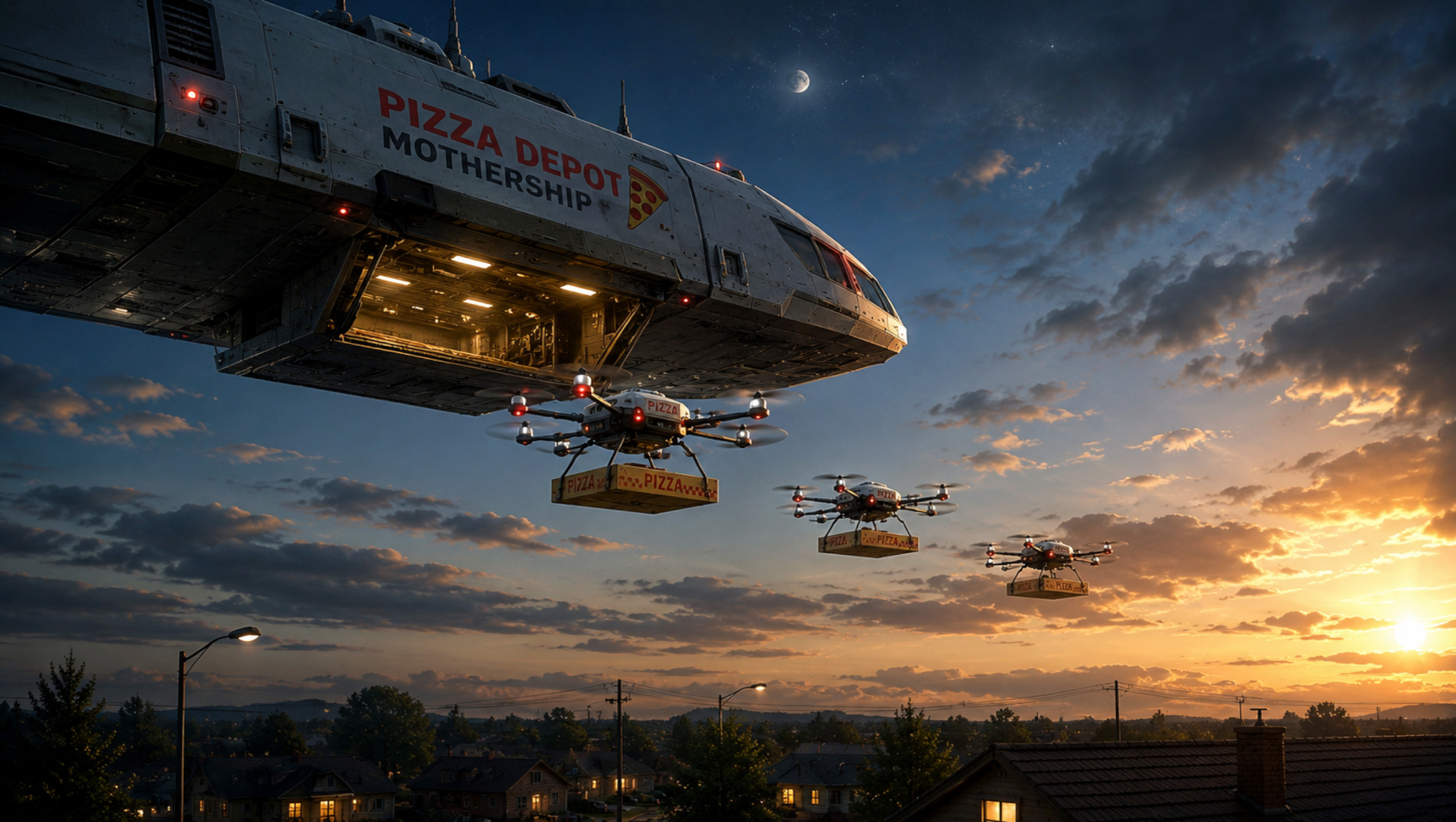
Erickson: “I don’t think it’ll just be individual drones flying single orders across town. You’ll probably see larger drones acting almost like motherships, transporting smaller delivery drones into neighborhoods where they can complete individual deliveries. Combined with advances in mapping, automation and autonomous navigation, you end up with a delivery ecosystem capable of handling far more orders than today’s systems. That’s where I think the technology is heading.
Since I already had the CEO of one of America’s leading agricultural drone companies on the line, I couldn’t resist shifting gears for a few minutes. Hylio’s day job isn’t pizza delivery—it’s helping farmers use fertilizer more efficiently. With fertilizer prices continuing to climb, I wanted to know how quickly those increases eventually find their way onto a pizza menu.
The answer wasn’t particularly encouraging. Erickson says today’s supply chain doesn’t leave much room for delays. Higher fertilizer costs eventually affect grains, tomatoes, livestock feed and dairy production, meaning nearly every major pizza ingredient can feel the impact. The good news, he says, is that precision agriculture gives farmers a way to use fewer inputs while maintaining yields, helping soften at least part of that financial blow.
Hernandez: How quickly do higher fertilizer costs affect restaurants?
Erickson: “Faster than people think. Most businesses aren’t sitting on huge inventories. Once existing inventory moves through the system, higher input costs start showing up pretty quickly. That affects everyone from farmers to grocery stores to restaurants.”
Hernandez: Can drone technology actually help reduce those costs?
Erickson: “By deploying our drones for precision agriculture, we’re solving a lot of problems at once. It’s cheaper, better, faster, stronger, safer. We’re helping farmers use fewer inputs, reduce waste and become more efficient while maintaining yields. That’s been Hylio’s mission from the beginning, and those efficiencies eventually benefit everyone throughout the food supply chain.”
I hung up the interview a little more convinced that drone-delivered pizza isn’t nearly as far away as most of us think. The technology is already here. The hardware can handle it. The software can navigate it. What’s left is proving the system is safe, practical and economical enough for regulators—and eventually consumers—to embrace it.
In the meantime, Erickson and the team at Hylio will keep doing what they’ve spent the last decade doing: building autonomous drone technology that helps farmers work smarter, waste less and produce more with fewer resources. It’s a mission that’s already making a difference in agriculture, and one that could someday extend well beyond the farm.
For now, Hylio remains focused on helping farmers work smarter and produce food more efficiently. But after talking with Erickson, it’s hard not to wonder whether the same technology could eventually help get a hot pizza from the oven to your front door.
By Brian Hernandez, PMQ Assoc. Editor, U.S. Pizza Team Director